Teen Patti Hands (2026): All Hands High to Low + Sequence List
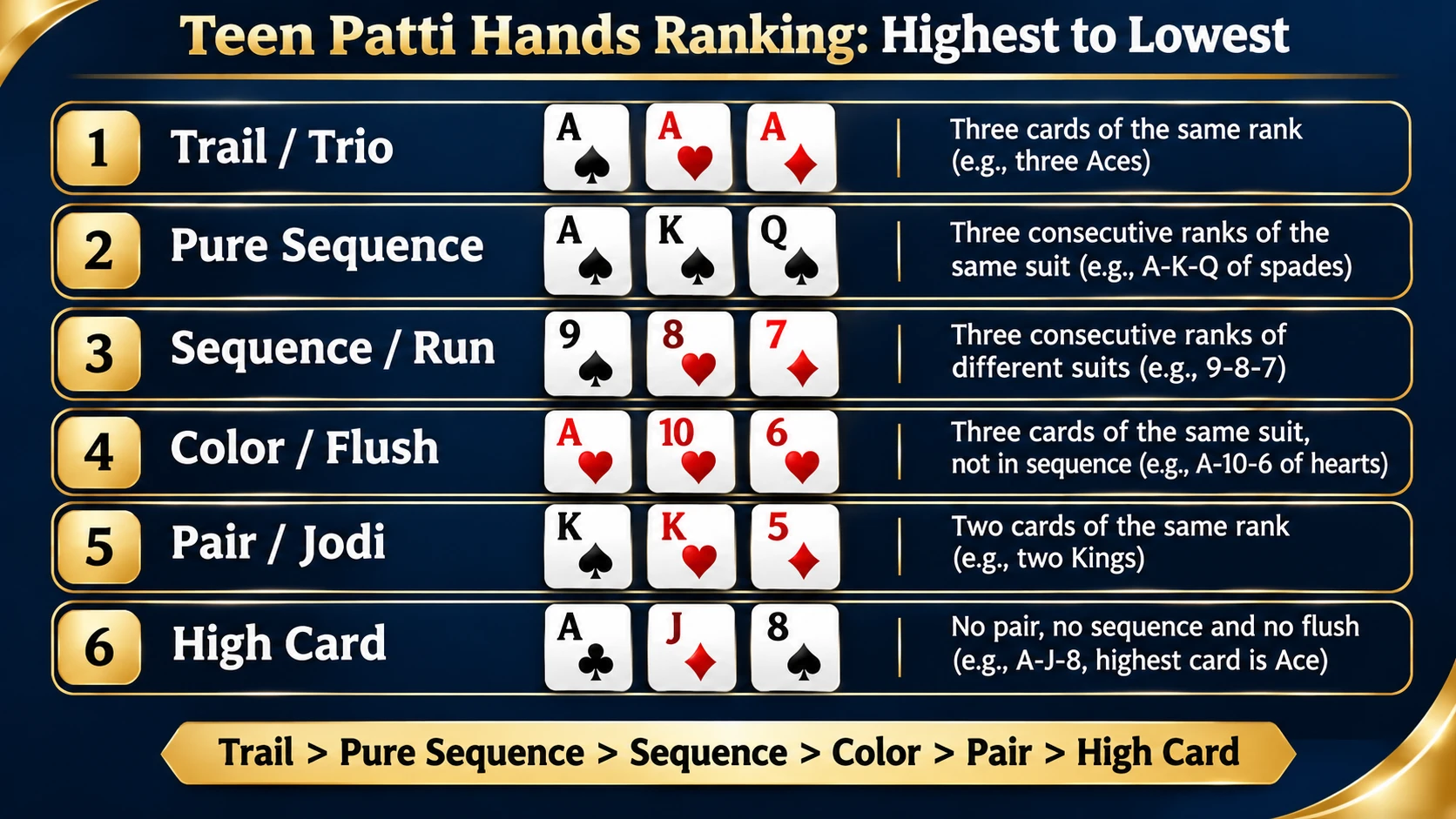
Teen Patti hands rank from strongest to weakest as Trail, Pure Sequence, Sequence, Color, Pair and High Card. A Trail (three cards of the same rank) beats every other hand; a Pure Sequence (three consecutive cards of one suit) beats a regular Sequence; a Sequence beats a Color; a Color beats a Pair; and a Pair beats a High Card.
Teen Patti is also called 3 Patti. Both names refer to the same three-card game and use the same standard hand categories.
The chart below shows all six hand rankings, what each combination means, and which lower-ranked hands it defeats.
Teen Patti Hands Ranking Chart: Highest to Lowest
| Rank | Hand | What It Is | Example | Beats |
|---|---|---|---|---|
| 1 | Trail / Trio | Three cards of the same rank | A♠ A♥ A♦ | Every other category |
| 2 | Pure Sequence | Three consecutive cards of the same suit | A♠ K♠ Q♠ | Sequence, Color, Pair, High Card |
| 3 | Sequence / Run | Three consecutive cards, not all of the same suit | 9♠ 8♥ 7♦ | Color, Pair, High Card |
| 4 | Color / Flush | Three cards of the same suit, not consecutive | A♥ 10♥ 6♥ | Pair, High Card |
| 5 | Pair / Jodi | Two cards of the same rank | K♠ K♥ 5♦ | High Card |
| 6 | High Card | No higher-ranking combination | A♣ J♦ 8♠ | Lower High Card hands |
A higher category always defeats a lower category under standard Teen Patti rules. Even the weakest Trail beats the strongest Pure Sequence, while the lowest Sequence beats the highest Color.
When both players hold the same category, their card values determine the stronger hand according to the table's comparison rules.
The Six Teen Patti Hand Rankings Explained
1. Trail or Trio (Three of a Kind)
Trail is the strongest hand in standard Teen Patti. It consists of three cards with the same rank, such as three Aces, three Kings or three 9s.
Example: A♠ A♥ A♦
Three Aces form the highest possible Trail, while three 2s form the lowest. A Trail is rare, but its strength comes from its category, not simply from how frequently it appears.
If two players have Trails, compare the ranks of their three cards. For example, K♠ K♥ K♦ beats 9♠ 9♥ 9♦.
2. Pure Sequence (Straight Flush)
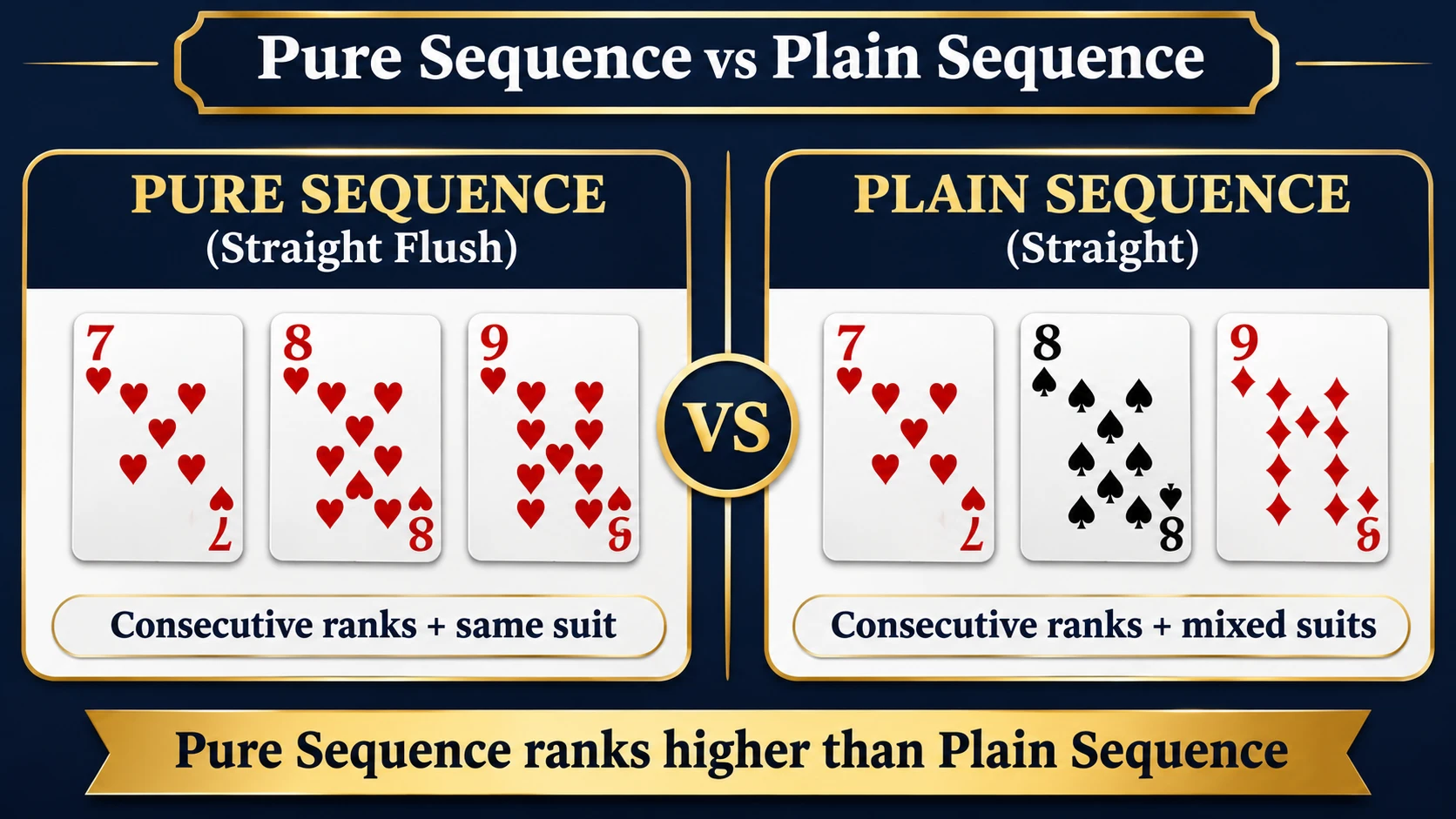
A Pure Sequence contains three consecutive cards of the same suit.
Example: 4♥ 5♥ 6♥
A Pure Sequence ranks second, below Trail but above every ordinary Sequence, Color, Pair and High Card. Its three cards must satisfy two conditions: consecutive ranks and a single suit.
For example, 7♣ 8♣ 9♣ is a Pure Sequence, while 7♣ 8♦ 9♥ is not.
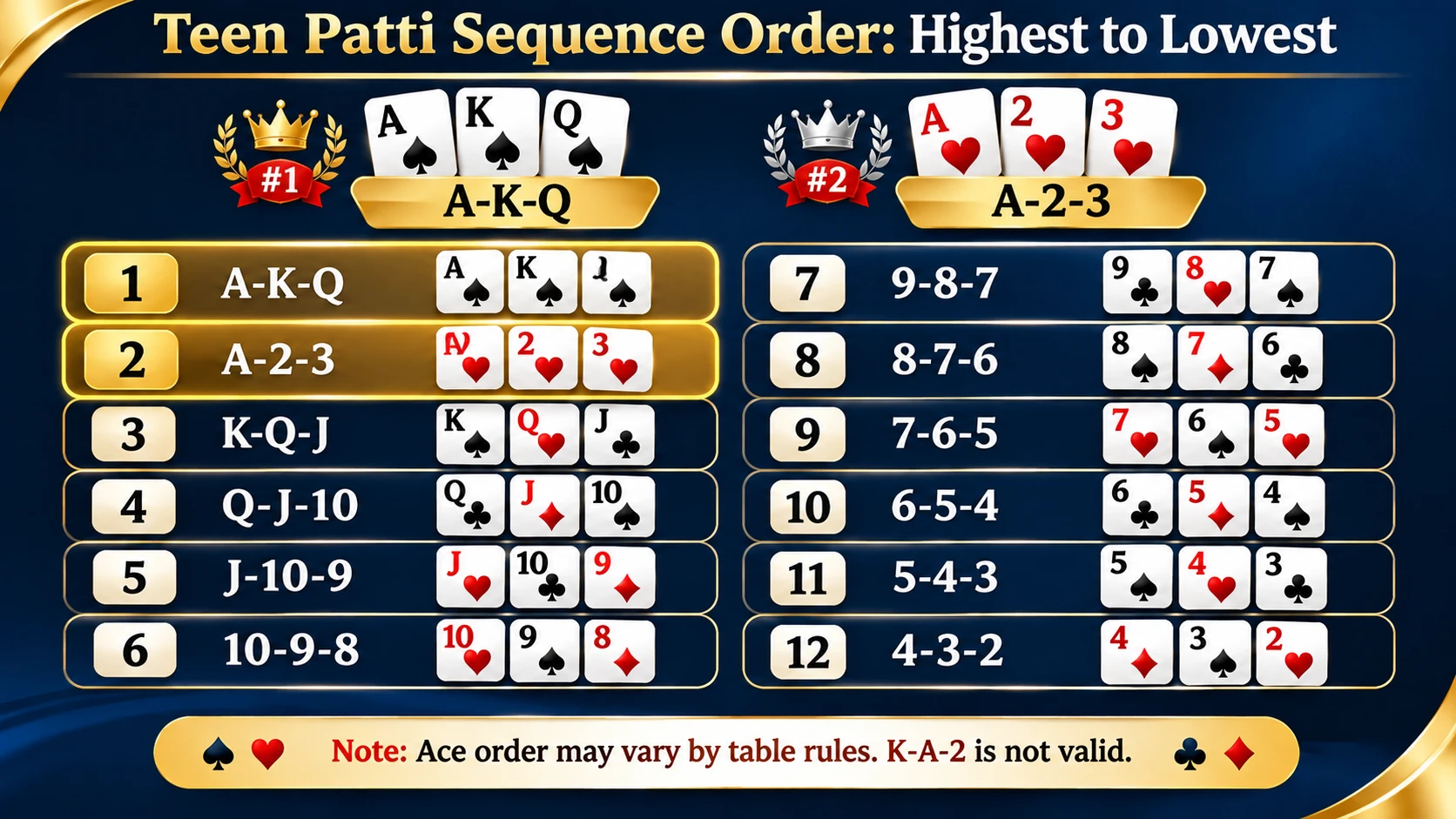
Under the sequence convention used in this guide, A‑K‑Q is the highest Pure Sequence, followed by A‑2‑3. Some traditional rules reverse these two, so players should confirm their table's Ace ranking.
3. Sequence or Run (Straight)
A Sequence contains three consecutive card ranks that are not all from the same suit.
Example: 7♥ 8♠ 9♣
A Sequence ranks below Pure Sequence but above Color, Pair and High Card. The cards do not need to be in the same suit, but they must form a valid three-card run.
A hand such as 9♠ 10♦ J♣ beats 5♠ 6♥ 7♦ because its sequence ranks higher.
If all three cards also share the same suit, the hand is classified as a Pure Sequence instead.
4. Color or Flush
A Color consists of three cards of the same suit that do not form a sequence.
Example: 2♦ 7♦ J♦
All three cards must belong to the same suit for the hand to qualify as a Color. Three red cards are not necessarily a Color: hearts and diamonds are separate suits.
When comparing two Colors, first compare their highest cards. If those are equal, compare the second-highest cards, followed by the lowest cards if necessary.
The suits themselves normally do not have a ranking in standard comparisons. House rules may differ.
5. Pair or Jodi (Two of a Kind)
A Pair contains two cards of the same rank and one card of a different rank.
Example: 6♥ 6♦ K♠
Pair is the second-weakest standard Teen Patti hand. It loses to Color, Sequence, Pure Sequence and Trail, but defeats High Card.
When two players both have a Pair, compare the paired ranks first. A pair of Kings beats a pair of Queens regardless of the third card.
If both pairs have the same rank, the remaining card, often called the kicker, determines the stronger hand.
6. High Card
High Card applies when the three cards do not form a Trail, Pure Sequence, Sequence, Color or Pair.
Example: K♠ 8♦ 3♣
High Card is the weakest hand category in Teen Patti.
When two players both hold High Card hands, compare their highest cards. If these are tied, compare the second-highest cards and then the third.
For example, A♠ J♦ 8♣ beats A♥ 10♣ 9♦ because Jack ranks above 10 after the Aces match.
Teen Patti Sequence List vs 3 Patti Sequence List — Same Order
The Teen Patti sequence list and the 3 Patti sequence list describe the same valid three-card runs. There are 12 distinct rank patterns, ranging from Ace-based combinations to 4‑3‑2. The main rule to check is how the table compares A‑K‑Q with A‑2‑3, since different versions of the game use different priorities.
The following table uses A‑K‑Q first and A‑2‑3 second, matching the convention adopted by this guide.
| Position | Sequence | Example (Pure Sequence) |
|---|---|---|
| 1 — Highest | A-K-Q | A♠ K♠ Q♠ |
| 2 | A-2-3 | A♥ 2♥ 3♥ |
| 3 | K-Q-J | K♠ Q♠ J♠ |
| 4 | Q-J-10 | Q♥ J♥ 10♥ |
| 5 | J-10-9 | J♣ 10♣ 9♣ |
| 6 | 10-9-8 | 10♦ 9♦ 8♦ |
| 7 | 9-8-7 | 9♠ 8♠ 7♠ |
| 8 | 8-7-6 | 8♥ 7♥ 6♥ |
| 9 | 7-6-5 | 7♣ 6♣ 5♣ |
| 10 | 6-5-4 | 6♦ 5♦ 4♦ |
| 11 | 5-4-3 | 5♠ 4♠ 3♠ |
| 12 — Lowest | 4-3-2 | 4♦ 3♦ 2♦ |
The same rank patterns apply to regular Sequences, except that the three cards must not all share the same suit.
K‑A‑2 is not a valid sequence. The Ace cannot wrap around between King and 2.
- A Pure Sequence contains consecutive cards of one suit.
- A regular Sequence contains consecutive ranks without all three cards sharing a suit.
- A Color contains three cards of one suit without a consecutive run.
A-K-Q vs A-2-3: Which Sequence Is Higher?
Under the convention used in this article, A‑K‑Q ranks above A‑2‑3, and A‑2‑3 ranks above K‑Q‑J. However, the relative order of A‑K‑Q and A‑2‑3 is a house-rule variation. Some traditional Teen Patti rules place A‑2‑3 first, while other versions place it second or treat it differently.
Three points resolve most confusion:
- A‑K‑Q and A‑2‑3 are both valid sequences.
- A‑2‑3 does not mean K‑A‑2 is also valid.
- Check the rules of the specific table or app before applying either Ace-ranking convention.
For example, where A‑K‑Q is ranked first, A♠ K♠ Q♠ defeats A♥ 2♥ 3♥ when both hands are Pure Sequences. A table following the opposite convention would reverse that result.
Which Is Bigger, Trail or Sequence in 3 Patti?
Trail is bigger than Sequence in standard 3 Patti. A Trail contains three cards of equal rank and holds the highest category position. A regular Sequence contains three consecutive ranks and sits third, below both Trail and Pure Sequence. The category decides the winner before individual card values are considered.
For example, 2♠ 2♥ 2♦ beats A♣ K♥ Q♦ despite the Trail containing only 2s.
- Trail ranks first among the six standard categories.
- Pure Sequence ranks second.
- Regular Sequence ranks third and cannot defeat a Trail under standard rules.
Special variants such as Muflis may change the objective and reverse hand rankings. This page explains the standard ranking order, not every variant.
What Are the Different Sequences in 3 Patti?
There are two sequence-based hand categories in standard 3 Patti: Pure Sequence and regular Sequence. Both require three consecutive card ranks, but Pure Sequence additionally requires all three cards to share one suit. Each category can use the 12 rank patterns listed above, subject to the Ace-order convention chosen for the table.
Examples include:
- Pure Sequence: 8♠ 9♠ 10♠.
- Regular Sequence: 8♠ 9♥ 10♦.
- Not a Sequence: 8♠ 10♥ Q♦, because the ranks are not consecutive.
A Pure Sequence always defeats a regular Sequence under standard category rankings. For example, 4♥ 5♥ 6♥ beats 10♠ J♦ Q♣, even though the regular Sequence contains higher card ranks.
What Is a Pure Sequence in 3 Patti?
A Pure Sequence in 3 Patti is a three-card hand with consecutive ranks, all belonging to the same suit. It is also called a Straight Flush or Pure Run. This combination ranks immediately below Trail and above regular Sequence, Color, Pair and High Card in the standard Teen Patti hand hierarchy.
To recognize it:
- Check that the three ranks are consecutive.
- Check that all three cards share the same suit.
- Check that the Ace, if present, forms a valid run under the table's rules.
For instance, Q♣ K♣ A♣ forms a Pure Sequence. Q♣ K♦ A♠ forms a regular Sequence, while Q♣ J♣ 8♣ is a Color.
How to Compare Two Teen Patti Hands of the Same Rank
When two players hold the same hand category, compare their card ranks according to that category's tie-breaking rules. A higher category still wins automatically, so these comparisons only apply when both hands are Trails, Sequences, Colors, Pairs or High Cards of the same type.
| Hand Type | Comparison Rule | Example |
|---|---|---|
| Trail | Higher set of three wins | K-K-K beats 9-9-9 |
| Pure Sequence | Higher-ranked valid run wins | A-K-Q beats Q-J-10 under this guide's convention |
| Sequence | Higher-ranked valid run wins | J-10-9 beats 8-7-6 |
| Color | Compare highest, then second, then third | A-10-6 beats A-9-8 |
| Pair | Compare pair ranks, then kicker | Q-Q-10 beats Q-Q-7 |
| High Card | Compare each card from highest downward | A-J-8 beats A-10-9 |
Suits do not normally break otherwise equal combinations. If the values are identical, the outcome depends on the showdown and tie rules of the table.
The Teen Patti Hands in Pictures
A visual ranking guide makes it easier to recognize the six categories without confusing card suits or consecutive ranks.
| Rank | Card Example | Hand Meaning |
|---|---|---|
| 1 — Trail | A♠ A♥ A♦ | Three cards share the same rank |
| 2 — Pure Sequence | 4♠ 5♠ 6♠ | Three consecutive cards share one suit |
| 3 — Sequence | 7♣ 8♦ 9♥ | Three consecutive ranks, mixed suits |
| 4 — Color | 2♥ 6♥ K♥ | One suit, without a sequence |
| 5 — Pair | Q♠ Q♦ 5♣ | Two matching ranks and one different card |
| 6 — High Card | A♣ 9♦ 4♠ | No qualifying combination |
Remember the order: Trail → Pure Sequence → Sequence → Color → Pair → High Card.
Frequently Asked Questions About Teen Patti Hand Rankings
1. Which is bigger, A23 or KQJ?
Under the sequence order used here, A‑2‑3 beats K‑Q‑J. However, some table variations place A‑2‑3 differently. Confirm the Ace convention before comparing these runs.
2. Does a Pure Sequence beat a Color?
Yes. A Pure Sequence ranks second, while Color ranks fourth. Any valid Pure Sequence defeats any Color under standard rules.
3. Is A-2-3 higher than K-Q-J in 3 Patti?
Yes, under the convention followed in this article. The main disputed comparison is A‑2‑3 versus A‑K‑Q, so the table rules should always be checked.
4. What is the 3 Patti sequence list?
The sequence list contains 12 possible three-rank patterns, including A‑K‑Q, A‑2‑3, K‑Q‑J and all consecutive runs down to 4‑3‑2. Each can form a Pure Sequence or regular Sequence depending on suits.
5. Is 3 Patti the same as Teen Patti?
Yes. 3 Patti is another name for Teen Patti. Both use three-card hands, and their standard hand categories have the same ranking order.
6. Does suit matter for a Color or Flush?
Yes. All three cards must be from the same suit to qualify as a Color. However, suits are not normally ranked against one another when comparing otherwise equal Colors.
7. Can two players have equally ranked hands?
Yes. Identical card values can produce equal-ranked combinations. The result depends on the table's tie and showdown rules, which may differ between traditional games and online versions.
Related Guides
Understanding the hand order is only one part of Teen Patti. For the complete gameplay process, including blind and seen play, betting, folding, side shows and common variations, read the complete Teen Patti rules and 3 Patti game guide.
Always check the rules of your particular table before playing.
18+ only. This is an informational guide. Real-money gaming laws vary by location.
About the Author
The author prepares educational guides explaining Teen Patti hand rankings, sequence combinations, and common rule variations. This article is intended to help readers understand the six standard hand categories and compare three-card sequences. Specific Ace-ranking and tie-breaking rules may vary between tables and game versions.
Last updated: November 2, 2026